COMMERCIAL VEHICLE SECURITY & EQUIPMENT SINCE 1992
 FR / EN / DE
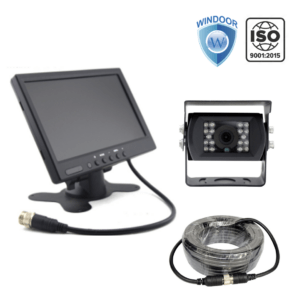
A reversing camera for an HGV is an essential parking and manoeuvring aid: it films the area around the vehicle and makes manoeuvres safer. Since 2005, WINDOOR has offered a professional range of reversing cameras for trucks and HGVs under its well-known CARE-VIEW® and VIGI-VIEW® brands.
Unlike recent cars, which often have one as standard, many trucks have no reversing camera. Adding one can make your truck much safer and easier to park.
IP rating: the ingress protection (IP) rating shows how well electrical equipment is protected against dust, water and accidental contact. Quality reversing cameras, such as WINDOOR’s, are rated IP68 or IP69K:
A high IP rating means the camera withstands the elements and works reliably in all conditions.
Resolution: the resolution of the camera and its monitor is crucial. Standard cameras offer HD resolution (1280 × 720 pixels), while high-end models reach Full HD (1920 × 1080 pixels). Higher resolution gives sharper images and more visible detail, especially on a monitor of 7 inches or more.
Operating temperature: cameras must work reliably in extreme conditions. WINDOOR cameras, for example, operate between -20 °C and 65 °C, so they stay reliable in very cold or very hot weather.
Vibration resistance: measured in “g” (acceleration due to gravity), vibration resistance is essential for trucks working in harsh conditions. High-quality systems withstand up to 10 g, like WINDOOR reversing cameras.
Wired cameras: wired cameras give better image quality and a more stable connection, which is essential to avoid losing the signal when reversing. They can cost more and need professional fitting, but they offer advanced features and unmatched reliability.
Wireless cameras: easy to fit and often cheaper, wireless cameras suit drivers looking for a quick solution. However, they can be prone to interference and sometimes need battery replacements.
Reversing cameras are useful on a wide range of vehicles:
Fitting a reversing camera has many benefits:
Some systems also include reversing sensors that beep as obstacles get closer, combining the camera image with audible warnings for extra safety.
Since 1 July 2024, all new vehicles sold in the EU must comply with the updated General Safety Regulation, GSR2, which supplements framework Regulation (EU) 2018/858. It makes advanced safety features mandatory to support the EU’s Vision Zero goal of eliminating road deaths and serious injuries by 2050.
Eleven active safety features are covered: most became mandatory on new vehicles in July 2024, and the others are being phased in in 2026 and 2029. They include:
These measures aim to reduce accidents caused by human error and improve road safety overall.
A reversing camera is a sound investment for the safety and driving comfort of your truck. Whether you choose a wired model for its superior image quality or a wireless one for easy fitting, the benefits are clear, and for new vehicles it is now also a legal requirement. Make sure you choose a camera whose specifications match your needs. With its expertise since 2005, WINDOOR is well placed to answer your requests.
For single-unit orders, you will find our best-sellers in our online shop.


